Queensland Institutions – Systemic Failure, Evidence Suppression, and Abuse of Power
This website documents a profound breakdown across Queensland’s justice, integrity, and oversight institutions. Despite being placed on notice—repeatedly and with extensive documentary evidence—these bodies have ignored, dismissed, obstructed, and unlawfully concealed material evidence, enabling serious misconduct to continue unchecked.
What occurred was not a series of isolated errors. It was a systemic pattern of protection, retaliation, and evidence suppression, spanning the executive, law enforcement, integrity agencies, courts, tribunals, and political oversight.
Queensland Department of Justice (DoJ)
The Queensland Department of Justice failed to act despite clear notice of fraud, judicial misconduct, suppression of evidence, and denial of procedural fairness. Rather than ensuring lawful administration of justice, the Department relied on silence, jurisdictional deflection, and technical evasions. Requests for records and explanations were refused or ignored, effectively shielding misconduct within courts and tribunals.
Queensland Police Service (QPS)
The Queensland Police Service declined to investigate credible complaints involving falsified evidence, financial crime, interference with judicial processes, and retaliation against a whistleblower. Documentary material was ignored, complaints were dismissed without investigation, and evidence known to exist was not disclosed.
Crime and Corruption Commission (CCC)
The Crime and Corruption Commission represents one of the most serious institutional failures. Despite extensive submissions, corroborated evidence, and clear jurisdiction, the CCC refused to investigate matters involving senior professionals, judicial officers, and public officials. Internal assessments, referral decisions, and correspondence were concealed, rendering meaningful review impossible and protecting entrenched interests.
Queensland Ombudsman
The Queensland Ombudsman failed to act as a safeguard of last resort. Complaints of systemic maladministration, evidence suppression, and agency collusion were dismissed or redirected without investigation. Records and assessments were withheld, legitimising inaction across government and denying any avenue of accountability.
Political Oversight – Deb Frecklington
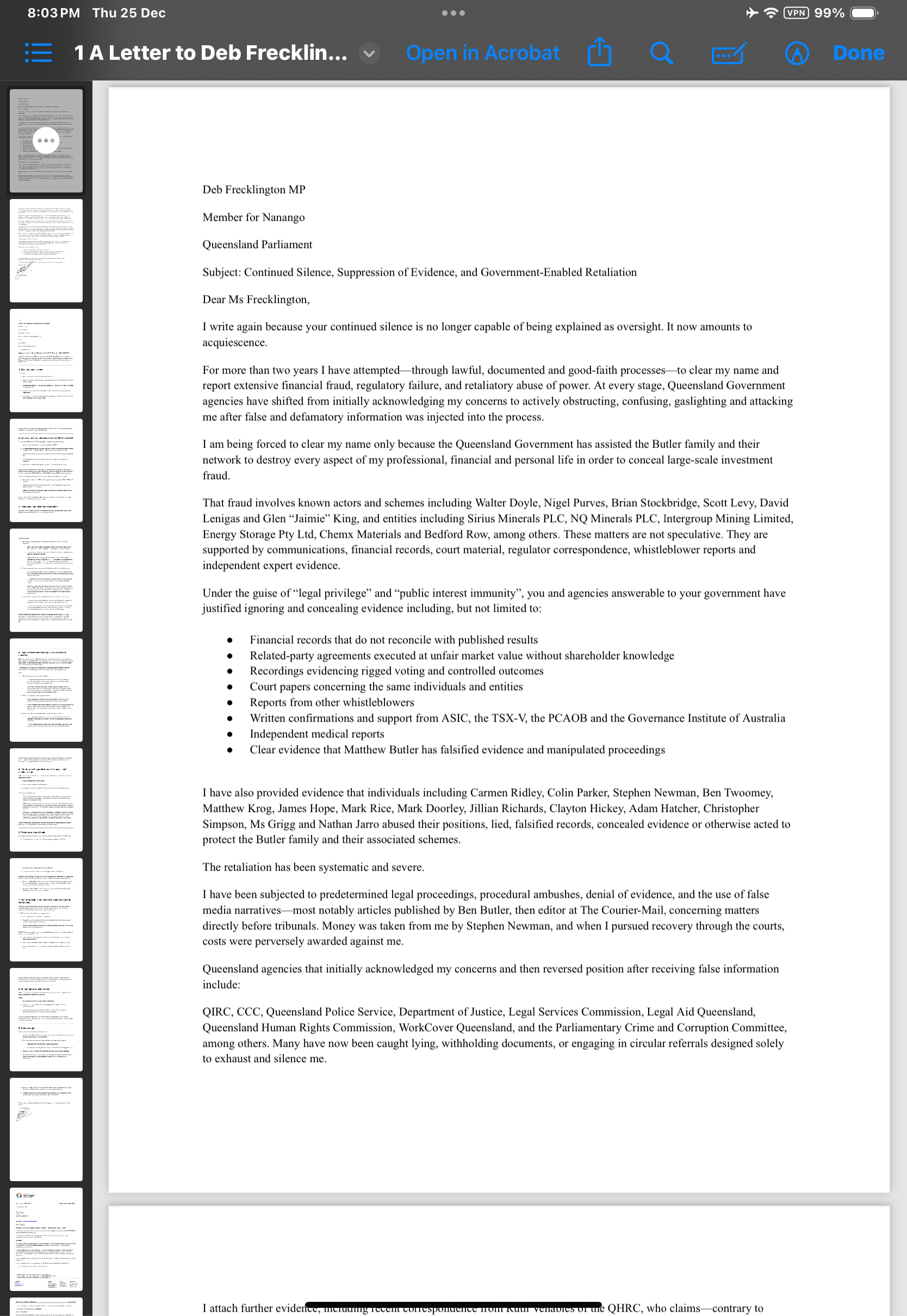
As Minister responsible for integrity-related portfolios during critical periods, Deb Frecklington was repeatedly notified of fraud, regulatory failure, judicial bias, and evidence suppression. No corrective action followed. This sustained silence, in the face of detailed evidence, raises serious concerns about political protection and the abdication of ministerial responsibility.
The District Court of Queensland – Fraudulent Hearings
Proceedings in the Queensland District Court, including hearings before Griggs and Jarro, were marked by:
Reliance on contested or falsified evidence;
Suppression and exclusion of relevant material;
Denial of procedural fairness;
Apparent predetermination and bias.
Evidence relied upon by the Court was not disclosed to all parties, while material adverse to protected individuals was excluded or ignored. These hearings functioned to legitimise outcomes already engineered elsewhere, rather than to adjudicate disputes impartially.
Industrial Tribunals – QIRC and FWC
The Queensland Industrial Relations Commission, including proceedings before Dwyer, mirrored the same failures. Evidence was ignored, whistleblower protections neutralised, and administrative power used to obstruct justice. The same pattern occurred federally within the Fair Work Commission, where regulator correspondence and key evidence were withheld or sidelined.
Unlawful Withholding and Concealment of Evidence
Across all institutions and individuals named on this website, a common and decisive wrongdoing emerges: the unlawful withholding, suppression, and concealment of evidence.
Evidence Withheld
The following categories of material were repeatedly withheld, denied, or concealed:
Primary documents and exhibits submitted by me
Internal correspondence and inter-agency communications
Complaint handling records, assessments, and memoranda
Hearing transcripts, recordings, and notes
Evidence relied upon by decision-makers but never disclosed
Records later proven to exist after being denied
In multiple instances, agencies falsely claimed documents did not exist, disclosed only partial records, or invoked privilege and immunity improperly to conceal material evidence.
Institutions Responsible
This evidence suppression occurred across:
Queensland DoJ
QPS
CCC
Queensland Ombudsman
Queensland District Court
QIRC and FWC
Professional and legal regulators
The concealment consistently operated to the benefit of the same protected individuals and networks, while evidence adverse to them was excluded and untested allegations were relied upon against me.
Why This Is Unlawful
The conduct described breaches fundamental legal obligations, including:
Procedural fairness and natural justice
Statutory RTI/FOI obligations
Disclosure duties of courts and tribunals
Record-keeping and transparency duties of regulators
Whistleblower protection frameworks
Decisions made while suppressing material evidence are unsafe, invalid, and unjust.
Why This Is a Public Danger
Collectively, these failures demonstrate a collapse of institutional independence:
Police do not investigate
Integrity bodies do not act
Courts and tribunals do not hear matters fairly
Politicians do not intervene
Oversight bodies do not hold anyone accountable
This environment allows fraud to flourish, whistleblowers to be punished, and public confidence in the rule of law to be destroyed.
Why This Is Documented Here
This website exists because every formal avenue failed. When institutions designed to protect the public instead protect power, the public record must reflect that failure.
What is documented here is not rhetoric. It is evidence of how systems fail—and why they must be exposed.Below is a single, consolidated final version combining the Queensland institutional failures and the unlawful withholding and concealment of evidence. It is written as a stand-alone definitive page for your website, suitable as a cornerstone reference document.
Queensland Institutions – Systemic Failure, Evidence Suppression, and Abuse of Power
This website documents a profound breakdown across Queensland’s justice, integrity, and oversight institutions. Despite being placed on notice—repeatedly and with extensive documentary evidence—these bodies have ignored, dismissed, obstructed, and unlawfully concealed material evidence, enabling serious misconduct to continue unchecked.
What occurred was not a series of isolated errors. It was a systemic pattern of protection, retaliation, and evidence suppression, spanning the executive, law enforcement, integrity agencies, courts, tribunals, and political oversight.
Queensland Department of Justice (DoJ)
The Queensland Department of Justice failed to act despite clear notice of fraud, judicial misconduct, suppression of evidence, and denial of procedural fairness. Rather than ensuring lawful administration of justice, the Department relied on silence, jurisdictional deflection, and technical evasions. Requests for records and explanations were refused or ignored, effectively shielding misconduct within courts and tribunals.
Queensland Police Service (QPS)
The Queensland Police Service declined to investigate credible complaints involving falsified evidence, financial crime, interference with judicial processes, and retaliation against a whistleblower. Documentary material was ignored, complaints were dismissed without investigation, and evidence known to exist was not disclosed.
Crime and Corruption Commission (CCC)
The Crime and Corruption Commission represents one of the most serious institutional failures. Despite extensive submissions, corroborated evidence, and clear jurisdiction, the CCC refused to investigate matters involving senior professionals, judicial officers, and public officials. Internal assessments, referral decisions, and correspondence were concealed, rendering meaningful review impossible and protecting entrenched interests.
Queensland Ombudsman
The Queensland Ombudsman failed to act as a safeguard of last resort. Complaints of systemic maladministration, evidence suppression, and agency collusion were dismissed or redirected without investigation. Records and assessments were withheld, legitimising inaction across government and denying any avenue of accountability.
Political Oversight – Deb Frecklington
As Minister responsible for integrity-related portfolios during critical periods, Deb Frecklington was repeatedly notified of fraud, regulatory failure, judicial bias, and evidence suppression. No corrective action followed. This sustained silence, in the face of detailed evidence, raises serious concerns about political protection and the abdication of ministerial responsibility.
The District Court of Queensland – Fraudulent Hearings
Proceedings in the Queensland District Court, including hearings before Griggs and Jarro, were marked by:
Reliance on contested or falsified evidence;
Suppression and exclusion of relevant material;
Denial of procedural fairness;
Apparent predetermination and bias.
Evidence relied upon by the Court was not disclosed to all parties, while material adverse to protected individuals was excluded or ignored. These hearings functioned to legitimise outcomes already engineered elsewhere, rather than to adjudicate disputes impartially.
Industrial Tribunals – QIRC and FWC
The Queensland Industrial Relations Commission, including proceedings before Dwyer, mirrored the same failures. Evidence was ignored, whistleblower protections neutralised, and administrative power used to obstruct justice. The same pattern occurred federally within the Fair Work Commission, where regulator correspondence and key evidence were withheld or sidelined.
Unlawful Withholding and Concealment of Evidence
Across all institutions and individuals named on this website, a common and decisive wrongdoing emerges: the unlawful withholding, suppression, and concealment of evidence.
Evidence Withheld
The following categories of material were repeatedly withheld, denied, or concealed:
Primary documents and exhibits submitted by me
Internal correspondence and inter-agency communications
Complaint handling records, assessments, and memoranda
Hearing transcripts, recordings, and notes
Evidence relied upon by decision-makers but never disclosed
Records later proven to exist after being denied
In multiple instances, agencies falsely claimed documents did not exist, disclosed only partial records, or invoked privilege and immunity improperly to conceal material evidence.
Institutions Responsible
This evidence suppression occurred across:
Queensland DoJ
QPS
CCC
Queensland Ombudsman
Queensland District Court
QIRC and FWC
Professional and legal regulators
The concealment consistently operated to the benefit of the same protected individuals and networks, while evidence adverse to them was excluded and untested allegations were relied upon against me.
Why This Is Unlawful
The conduct described breaches fundamental legal obligations, including:
Procedural fairness and natural justice
Statutory RTI/FOI obligations
Disclosure duties of courts and tribunals
Record-keeping and transparency duties of regulators
Whistleblower protection frameworks
Decisions made while suppressing material evidence are unsafe, invalid, and unjust.
Why This Is a Public Danger
Collectively, these failures demonstrate a collapse of institutional independence:
Police do not investigate
Integrity bodies do not act
Courts and tribunals do not hear matters fairly
Politicians do not intervene
Oversight bodies do not hold anyone accountable
This environment allows fraud to flourish, whistleblowers to be punished, and public confidence in the rule of law to be destroyed.
Why This Is Documented Here
This website exists because every formal avenue failed. When institutions designed to protect the public instead protect power, the public record must reflect that failure.
What is documented here is not rhetoric. It is evidence of how systems fail—and why they must be exposed.