https://drive.google.com/file/d/1lzXit874EiCMMy6T31rmvRDvpjfUmEAt/view?usp=sharing - Recording of Justice Lee’s fraudulent hearing.
RESPONSE TO THE CRIMINAL FIONA MEAGHER - 22 September 2026
Subject: QUD648/2025 and QUD551/2025 – Response to 18 September 2026 Orders – Non-Attendance, Formal Procedural Objection and Transcript Request
Dear Registry,
I refer to Justice Meagher’s orders made in Chambers on 18 September 2026 in QUD648/2025 and QUD551/2025, and to the Court’s email of 18 September 2026 concerning my availability for a case-management hearing.
This email is sent pursuant to those orders and is intended to address my availability and matters reasonably incidental to the proposed case-management hearing.
I do not presently intend to participate in another hearing before Justice Meagher
I have no present intention of nominating availability for, or voluntarily participating in, another case-management hearing before Justice Meagher.
That position is not an abandonment or discontinuance of either proceeding. It is not consent to any order. It is not a withdrawal of my evidence, allegations, applications, objections or appellate rights.
It is a formal objection to the continued management of my proceedings in circumstances where I contend that I have repeatedly been denied a fair and effective opportunity to have my evidence addressed and where I have already raised apprehended-bias and procedural-fairness concerns.
I require this distinction to be recorded accurately on both Court files.
My evidence has still not been determined
I fundamentally reject the repeated characterisation of my case as unsupported merely because courts and other institutions have declined to determine the underlying evidence.
My material includes extensive affidavits, contemporaneous correspondence, recordings and transcripts, corporate records, ASIC material, regulatory correspondence, employment records, medical evidence, FOI material and documentary evidence concerning representations made about me and the persons and entities about whom I have complained.
I do not contend that the existence of those documents automatically proves every allegation I have made.
I contend that they require proper examination.
That distinction is critical.
I have repeatedly encountered a circular process in which I produce evidence; the substantive evidence is not determined; an adverse procedural decision follows; that decision is then relied upon by another decision-maker; and my continued attempts to have the primary evidence examined are characterised as unreasonable.
I reject that process.
Justice Meagher’s own latest reasons confirm that the substantive merits have not been heard
This is particularly important following Reeve v Fair Work Commission (No 2) [2026] FCA 1295.
Justice Meagher expressly stated at [41]:
“These proceedings are not yet at a point where there has been argument as to the merits of the applicant’s substantive applications or the fourth respondent’s Removal of Respondent Application.”
That is an important admission about the procedural position.
The substantive merits have not yet been argued.
Accordingly, I will not accept any suggestion that the extensive evidence underlying my substantive case has already been judicially determined and rejected.
It has not.
Justice Lee himself referred to an “ultimate trial”
This is also consistent with what Justice Lee told me during the 23 July 2026 leave hearing.
Justice Lee expressly said:
“I want to make it clear that I am not making decisions as to the underlying substantive merits of your complaint in the two proceedings.”
He subsequently told me, concerning relevant evidence:
“Presumably you will be in a position to adduce evidence in relation to those matters to the extent that it is relevant at an ultimate trial.”
I therefore require a clear answer:
When and how are the substantive merits actually going to be heard?
What is the proposed process for the “ultimate trial” to which Justice Lee referred?
What evidence will I be permitted to rely upon?
What evidence is presently on the Court file?
What evidence has been rejected from filing and why?
What applications remain outstanding?
What evidence do the respondents intend to rely upon?
Will disputed evidence be tested?
Will cross-examination be available where appropriate?
These are elementary procedural questions and I require clear answers before I am expected to participate meaningfully in further case management.
I maintain my objection concerning apprehended bias
I also expressly maintain the apprehended-bias concerns previously raised concerning Justice Meagher.
I appreciate that my application was dismissed and that Justice Lee subsequently refused leave to appeal.
That procedural history does not require me to pretend that I no longer hold the concerns or prevent me from preserving properly available grounds for later appellate review.
I therefore object to Justice Meagher continuing to determine contested matters involving my substantive rights and expressly preserve my position concerning apprehended bias.
My concerns about Justice Lee also remain
I further preserve my concerns concerning Justice Lee’s conduct of the 23 July hearing.
Justice Lee ultimately directed that:
“the audio feed of Mr Reeve to the Court be silenced”
while saying that he wished to ensure I could hear his reasons.
My connection subsequently ended and the remainder of the reasons were delivered in my absence.
I dispute aspects of the subsequent characterisation of how that occurred.
That dispute can be resolved objectively by preserving and producing the Court’s audiovisual and technical connection records.
I therefore again request their preservation.
I have also raised concerns about Justice Lee’s subsequent participation in an exclusive Rampart interview published on 30 August 2026, given that Ben Butler publishes with Rampart and is relevant to factual matters I have repeatedly sought to raise.
I am not asserting as an established fact that the interview constituted consideration for a judicial outcome.
I am saying that the chronology and circumstances warrant transparency, including when the interview was proposed, arranged and recorded and whether there was any relevant involvement by Ben Butler.
Those concerns remain expressly preserved.
My treatment by the Court
I also formally record my profound dissatisfaction with my treatment by Federal Court personnel throughout these proceedings.
I contend that I have encountered inconsistent filing instructions, restrictions upon communication, difficulty establishing precisely what material is before the Court, difficulty obtaining records, and procedures which have materially impaired my ability as a self-represented litigant residing overseas to present my case.
The orders now governing my communications illustrate the problem starkly.
Justice Lee’s orders of 31 July prevent email addresses controlled or used by me from communicating with Court email addresses and prevent documents submitted by me from being accepted unless a judge first determines that they contain no scandalous, abusive or otherwise inappropriate material.
Justice Meagher’s orders of 18 September now temporarily permit me to send no more than three emails, to a single Court address, during a period ending at 4:00 pm AEST on 23 September.
I regard this as an extraordinary restriction upon a self-represented litigant’s ability to communicate with the Court conducting his proceedings.
I reserve every right to challenge those restrictions through the procedures available to me.
Transcripts and recordings
Given the procedural history, transcripts are no longer optional conveniences. They are necessary to allow me to understand, document and, where appropriate, challenge what has occurred.
I therefore request that the Court provide me, without charge, with electronic copies of all available transcripts for hearings in QUD648/2025 and QUD551/2025, together with the complete transcript of the 23 July 2026 hearing concerning QUD280/2026 and QUD286/2026.
If the Registry considers that it cannot provide any transcript without charge, please do not merely refuse the request.
Please identify:
the statutory, regulatory or administrative basis for the proposed charge;
the amount sought for each transcript;
who presently holds the transcript;
whether the Court itself possesses an electronic copy;
the process for seeking waiver or remission of the charge on financial-hardship or access-to-justice grounds;
whether a transcript may be provided pursuant to judicial direction;
whether an audio or audiovisual recording is available instead; and
how I may obtain that recording.
I am overseas, self-represented, have repeatedly explained my financial circumstances, and require these materials for the conduct of the proceedings and preservation of appellate rights.
I therefore request that any available discretion to provide the material without charge be exercised in my favour.
Preservation of records
I also request immediate preservation of:
all audio and audiovisual recordings of my hearings;
official and draft transcripts;
Webex attendance and participant records;
connection and disconnection timestamps;
host and administrative logs;
records capable of establishing whether a participant disconnected voluntarily, lost connection, was removed or otherwise ceased participating;
Registry notes concerning my hearings;
communications concerning my participation by video;
communications concerning acceptance or rejection of my filings; and
records concerning the implementation of the 31 July communication restrictions.
This request is made because those records may be relevant to existing or prospective appellate proceedings.
They should not be destroyed under any ordinary records-management process while their relevance remains live.
What I require before further case management
I require the Registry to place this email on both QUD648/2025 and QUD551/2025 and provide it to Justice Meagher as my formal response to the proposed case-management hearing.
I also request written confirmation of:
the precise purpose of the proposed case-management hearing;
every application presently outstanding in each proceeding;
whether any substantive application is proposed to be determined at that hearing;
the evidence presently treated as filed and before the Court;
the procedure proposed for determination of the substantive merits;
whether a final substantive hearing or trial will occur;
the procedure by which I may obtain all relevant transcripts and recordings without charge;
confirmation that the records identified above will be preserved; and
confirmation that my non-attendance at the proposed case-management hearing will not be treated as discontinuance, abandonment, consent to orders or withdrawal of evidence without prior notice to me and identification of the legal basis upon which such a consequence is proposed.
I am not withdrawing either proceeding.
I am not abandoning my evidence.
I am not consenting to adverse orders.
I am not waiving my objections.
I am not consenting to Justice Meagher’s continued involvement.
I am recording that, after the procedural history to date, I do not consider another hearing before Justice Meagher to provide an acceptable means of protecting my right to a fair determination.
What I continue to seek is straightforward:
Access to the Court.
Access to the record.
A clear identification of the case I must meet.
A proper opportunity to present my evidence.
And determination of that evidence according to law.
Please place this correspondence on both files and confirm receipt.
Yours faithfully,
Oliver James Reeve
When a Judge Stops Listening
Serious Questions About Justice Michael Lee, the extensive drinking problem affecting his ability, the Reeve Hearing and an Extraordinary Subsequent Media Appearance
There is a point at which judicial robustness ceases to look robust and starts demanding scrutiny.
My hearing before Federal Court Justice Michael Lee on 23 July 2026 reached that point.
This was supposed to be an application for leave to appeal concerning one of the most fundamental requirements of Australian justice: whether proceedings were, and appeared to be, determined impartially.
I arrived with an extensive documentary history.
I had affidavits. Court records. Regulatory correspondence. transcripts. Medical material. Employment evidence. FOI material. A chronology extending across years. And, most importantly, evidence that I said had to be considered cumulatively when determining whether my concerns about the administration of my proceedings were reasonably arguable.
Justice Lee dismissed both applications with costs.
But what deserves scrutiny is not simply that I lost.
It is how the hearing unfolded, what Lee said about the evidence, what he subsequently wrote about me, and what happened in the weeks immediately afterwards.
The evidence was not some imaginary pile of paper
It is convenient to portray a self-represented litigant as someone who simply turns up angry and starts making accusations.
That is not an accurate description of the material I placed before the Court.
My appellate affidavit expressly explained that the recusal case depended upon the cumulative procedural history.
It identified thousands of pages of documentary material I had spent months preparing and organising. It identified affidavits, indexes, chronologies, exhibit schedules, searchable evidence books, regulatory records, medical evidence and transcripts.
The affidavit expressly said that I was not arguing that every procedural ruling I disliked established bias.
I asked for something considerably more orthodox: that the chronology and documentary record be considered together in applying the legal test for apprehended bias.
That distinction matters.
An apprehended-bias application does not require a litigant first to prove that a judge is corrupt.
The issue is the appearance of impartiality.
Yet Justice Lee’s reasons reduced my case to one which supposedly had “no evidentiary foundation” and “no reasonable prospects of success”.
That conclusion should be examined against what was actually filed, rather than simply repeated because a Federal Court judge wrote it.
Lee himself said he was not determining the underlying evidence
There is an even more important contradiction.
During the hearing, Justice Lee expressly told me that he was not deciding the underlying substantive merits of my two proceedings.
When I attempted to explain why the underlying evidence mattered, Lee distinguished the leave application from the eventual determination of the substantive case.
He went further.
He told me that, provided evidence related to relief sought in the underlying proceeding, I would presumably be able to adduce it to the extent relevant “at an ultimate trial.”
That statement matters enormously.
It recognised exactly what I was attempting to explain: the leave hearing was not the trial of the underlying allegations.
Yet Lee’s subsequent reasons use sweeping language about the supposed absence of evidentiary foundation for matters whose underlying merits he had expressly said he was not determining.
Those two positions deserve reconciliation.
Then the judge decided he had heard enough
The hearing became increasingly hostile.
I became angry. I used language I should expect a judge to dislike.
None of that makes evidence disappear.
Anger is not a legal doctrine.
Profanity does not prove the respondents’ evidence.
Being difficult does not retrospectively turn documents into blank pages.
And judicial irritation is not a substitute for determining whether an asserted error is reasonably arguable.
Eventually Justice Lee directed that my audio feed to the Court be silenced.
His own published reasons reproduce the direction.
He said he wished my audio silenced while simultaneously saying he wanted me to have the opportunity to hear his reasons in full.
My electronic participation subsequently ended.
Lee delivered the balance of his reasons in my absence.
He later characterised the disconnection as something I had done myself.
That factual dispute is one reason I have sought preservation and production of the underlying technical records rather than simply accepting a judicial assertion as infallible.
A court record should be capable of answering what happened.
The judgment then became remarkably personal
The subsequent published reasons devoted substantial attention to my language and communications.
Lee described me as a “querulous litigant”.
He reproduced abusive emails I sent after the hearing.
He imposed extraordinary restrictions preventing email addresses controlled by me from transmitting communications to Court email addresses and requiring judicial screening before documents submitted by me could be accepted for filing.
Nobody needs to approve of my language to understand the seriousness of those orders.
The issue is not whether I was polite.
The issue is whether judicial power was exercised fairly, proportionately and independently of the judge’s understandable personal reaction to criticism directed at him.
A judge can condemn abuse.
A judge can control a courtroom.
A judge can impose legitimate case-management requirements.
But the more personally acrimonious the relationship between judge and litigant becomes, the more important transparent and dispassionate decision-making becomes.
Judicial authority is not strengthened by barking louder than the person in front of the bench.
It is strengthened by demonstrating, patiently and precisely, why that person is wrong.
Then came Rampart
And then something extraordinary happened.
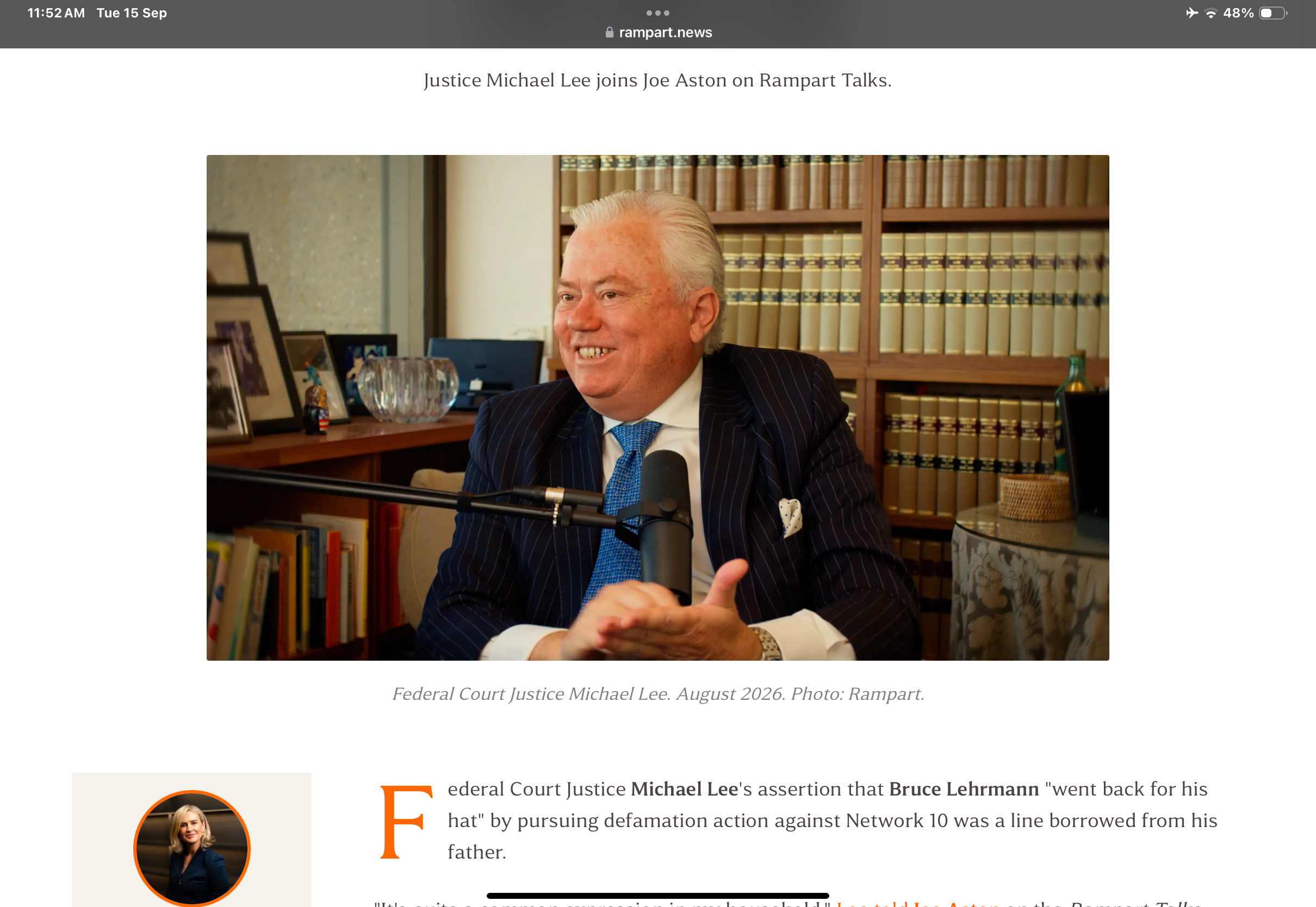
On 30 August 2026 — a little over five weeks after my hearing — Rampart published an exclusive interview with Justice Michael Lee.
This is not speculation.
The interview exists.
Rampart describes it as “Rampart Talks: Justice Michael Lee”.
Joe Aston interviewed him.
The full interview was offered as exclusive content to Rampart subscribers.
And Rampart is also a publication for which Ben Butler writes.
That matters to me because Ben Butler is not some random Australian journalist who happens to work at the same publication.
Butler features in the factual matrix I have repeatedly attempted to place before Australian institutions and courts.
That does not, without more, prove that Ben Butler arranged the interview.
It does not prove that Justice Lee knew about my allegations concerning Butler.
It does not prove that the interview was consideration for a judicial outcome.
And I am not going to manufacture evidence that I do not possess.
But the chronology is sufficiently extraordinary that I believe transparency is warranted.
When was Justice Lee approached?
Who approached him?
When did he agree?
When was the interview recorded?
Did negotiations or discussions concerning it pre-date my 23 July hearing?
Did Ben Butler have any role whatsoever in proposing, arranging, facilitating, producing or promoting it?
Was Justice Lee aware that Butler worked with Rampart?
Was he aware that Butler featured in the factual matters I was attempting to raise?
Was any hospitality, payment or other benefit provided in connection with the interview?
These questions have answers.
If the answers demonstrate absolutely no connection, excellent.
Publish them.
Transparency is how appearances are resolved.
A judge talking about institutional trust — behind a paywall
There is another remarkable aspect to the Rampart interview.
Rampart promoted Lee discussing the erosion of trust in courts and institutions.
That is precisely why this matters.
Public confidence in courts does not depend upon citizens treating judges as untouchable.
It depends upon judges exercising enormous public power in circumstances that withstand scrutiny.
The Rampart interview was not an incidental quotation obtained on the courthouse steps.
It was a substantial media product.
The publicly available excerpt runs for approximately 17 minutes, while Rampart promoted the full subscriber interview as approximately 82 minutes.
It was commercial subscription content, with Rampart Talks identifying commercial sponsors.
That does not establish wrongdoing by Lee.
It does demonstrate that this was a significant and valuable piece of editorial content for a commercial media organisation.
When a federal judge voluntarily participates in that sort of exclusive media product shortly after determining litigation involving a person who has raised serious matters concerning somebody working at that publication, asking about the chronology is not an attack on judicial independence.
It is exactly the sort of transparency that protects judicial independence.
And then there is the extraordinary AFR profile
Justice Lee’s public media persona deserves scrutiny for another reason.
On 19 December 2025, the Australian Financial Review published an article carrying the extraordinary headline:
“Four hours (and 18 drinks) in the lion’s den with Michael Lee.”
Precision matters here.
The article does not establish that Lee personally consumed 18 drinks.
The reported figure concerned approximately 18 standard drinks consumed between Lee and journalist Hannah Wootton during a roughly four-hour lunch.
Nor does that article establish that Justice Lee is an alcoholic.
I will not pretend it proves something it does not.
But neither should the episode be sanitised.
It is an extraordinary piece of published material concerning a serving Federal Court judge.
Even more remarkably, Lee subsequently cited the AFR article himself in a Federal Court speech in August 2026.
So the article is not some obscure internet allegation that can simply be dismissed as malicious gossip.
The judge himself has publicly referenced it.
I make no medical diagnosis of Justice Lee.
I do, however, believe Australians are entitled to ask what standards they expect of holders of immense judicial power and whether a deliberately cultivated public persona of this kind enhances confidence in the institution.
My criticism of Lee should be answered with evidence, not judicial status
Justice Lee may think I am unreasonable.
I think his handling of my applications was profoundly inadequate.
Neither proposition proves itself.
That is why evidence matters.
If my documentary case was irrelevant, identify it and explain why.
If I misunderstood the apprehended-bias test, identify precisely where.
If the evidence could not establish the necessary connection, demonstrate the missing link.
If the Rampart interview was arranged wholly independently of anything connected with my proceeding, disclose the chronology and end the issue.
If the technical record establishes that I deliberately disconnected from the hearing, preserve and produce it.
These are all factual propositions capable of proof.
What I will no longer accept is institutional authority being treated as a substitute for evidence.
The most disturbing part is the circularity
My experience has increasingly followed the same pattern.
I raise evidence.
An institution makes an adverse decision without determining the underlying evidence.
The next institution relies upon the first decision.
I challenge that reliance.
The challenge is characterised as unreasonable because an earlier institution has already rejected me.
I seek disclosure to establish what actually occurred.
Disclosure becomes another procedural battle.
I raise apprehended bias.
The recusal application is rejected.
I seek appellate review.
Justice Lee says the substantive evidence is not being determined because that belongs at an “ultimate trial”.
He nevertheless rejects the appeal as lacking reasonable prospects.
The reasons then devote substantial space to my conduct and language.
And weeks later Lee appears in an exclusive Rampart interview while discussing public confidence in courts.
At some point Australians should be permitted to ask whether this is what meaningful access to justice is supposed to look like.
Judicial independence is not judicial immunity from criticism
I understand why judges require independence.
I support it.
A judge should never decide a case because a politician, journalist, wealthy family, corporation or angry litigant wants a particular result.
But independence works both ways.
Judicial independence means independence from everybody.
It does not mean insulation from scrutiny.
It does not mean that extraordinary coincidences cannot be questioned.
It does not mean a judge’s reasoning becomes fact merely because it appears beneath the Commonwealth Coat of Arms.
And it certainly does not mean that a self-represented litigant forfeits the right to have evidence considered because he becomes furious at a system he believes has repeatedly failed him.
I do not ask readers to accept every allegation I have made.
I ask them to look at the documents.
Look at the transcript.
Look at what I actually put before the Court.
Look at what Justice Lee actually said.
Look at the orders he actually made.
Look at the chronology.
Look at the Rampart interview.
Then ask the question that matters:
Did this process look like the careful, detached and evidence-driven administration of justice Australians are entitled to expect from a Federal Court judge?
I believe the answer is no.
And I intend to keep pursuing that question through lawful appellate, oversight and public processes until the evidence — rather than institutional self-protection — finally provides the answer.