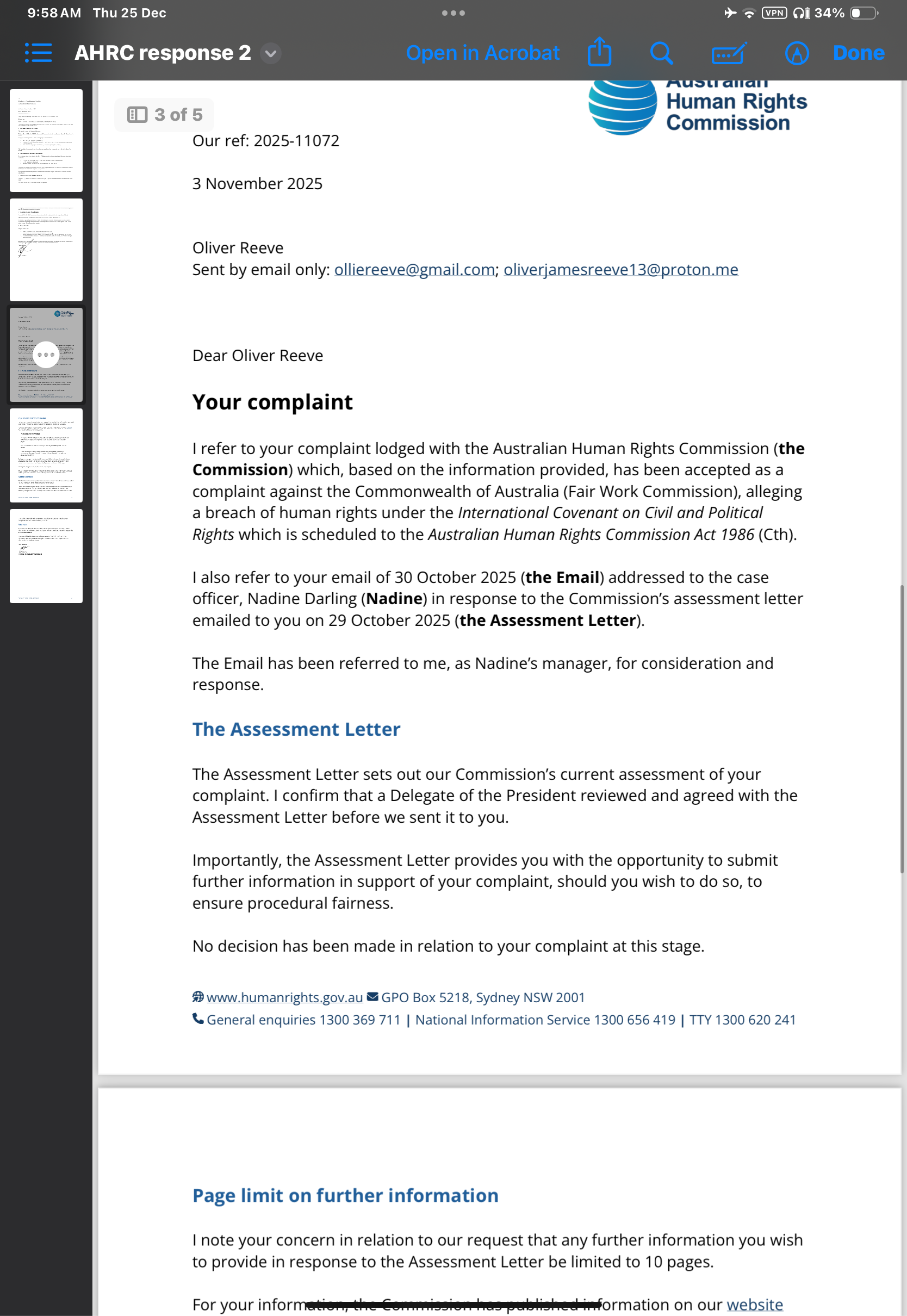
Australian Human Rights Commission (AHRC) – Failure to Protect, Misrepresentation, and Evidence Suppression
The Australian Human Rights Commission is mandated to protect individuals from discrimination, victimisation, and abuse of power—particularly where complaints involve state institutions or systemic misconduct. In my case, the AHRC failed to discharge that mandate. Instead of acting as an independent safeguard, it mirrored the same patterns seen across other agencies: dismissal of primary evidence, reliance on undisclosed material, and unlawful refusal of access to information.
Failure to Engage With the Evidence
My submissions to the AHRC were comprehensive and supported by extensive first-hand evidence, including sworn material, regulator correspondence, contemporaneous records, medical evidence, and documentation demonstrating retaliation and denial of procedural fairness across multiple institutions.
Despite this, the AHRC:
Failed to conduct a genuine assessment of the evidence presented;
Treated the complaint as an administrative matter rather than a human rights issue;
Provided conclusions without transparent reasoning;
Did not meaningfully address allegations of victimisation, institutional retaliation, or systemic abuse of power.
The Commission’s engagement was superficial and outcome-driven, not investigative.
Reliance on Undisclosed and Untested Material
Consistent with the pattern seen across other regulators, the AHRC asserted that it had access to external information adverse to me, which it relied upon in determining the matter. However:
That material was never disclosed;
Its source, accuracy, and provenance were not identified;
I was denied any opportunity to review or respond to it.
This approach violates fundamental principles of procedural fairness, particularly where secret material is used to discredit a complainant while their first-hand evidence is ignored.
Denial, Admission, and Continued Refusal
As with other agencies, the AHRC initially denied holding certain records and information relevant to my complaint. Subsequently, it acknowledged in writing that relevant information did exist or had been considered. Despite this admission, the Commission has continued to refuse access to that material.
The grounds relied upon for refusal have been inconsistent and improperly applied, including:
Misuse of confidentiality provisions;
Incorrect reliance on exemptions to avoid scrutiny;
Reframing requests to place them outside statutory access regimes.
This sequence—denial → reliance → admission → refusal—is now a recurring feature across human rights and integrity bodies.
Unlawful Withholding of Evidence
The AHRC has withheld:
Internal assessments and decision-making records;
Communications with other agencies and respondents;
Records of external material relied upon;
Documents necessary to test the lawfulness of its conclusions.
By doing so, the Commission has prevented any effective review of its conduct and undermined confidence in its independence.
Why This Is a Serious Public Concern
The AHRC is intended to be a national safeguard for individuals facing discrimination and institutional abuse. When it:
Ignores substantial first-hand evidence,
Relies on secret and undisclosed material,
Misrepresents what information it holds, and
Refuses lawful access after admitting possession,
it fails not only the complainant, but the broader public.
This conduct signals that human rights protections are selectively applied, particularly where complaints implicate powerful institutions or entrenched interests.
Why This Is Documented Here
The AHRC’s conduct is recorded on this website because human rights oversight cannot function where evidence is concealed and complainants are misled. Transparency and procedural fairness are not optional—they are the minimum standards required of any human rights body.
When those standards are abandoned, the public record must reflect it.